How Many Solar Panels Do I Need For My Home?
If you are asking how many solar panels do I need, there is no single number that works for every home. Your ideal system depends on your electricity consumption, available roof space, roof direction and shading, the output of the panels being installed, and how your energy needs may change in future.
As a useful benchmark, Energy Saving Trust says an average 4.5kWp solar system typically uses around 12 panels and requires roughly 20 to 30m² of roof space. That does not mean every home needs 12 panels. Some properties will benefit from fewer, while others have the roof space and electricity demand to justify considerably more.
The best approach is to treat online estimates as a starting point, then size the system around your actual property and energy use.
The Short Answer: Your Home May Need Around 4 To 16 Panels
As a broad guide, Energy Saving Trust currently suggests that the number of panels that can typically fit on different UK homes may look like this:
- Mid-terrace house: around 4 panels
- End-terrace or semi-detached house: around 8 panels
- Small detached house: around 12 panels
- Large detached house: around 16 panels
These figures are useful for understanding roof capacity, but they should not be treated as a recommendation for how many panels you personally need.
Two similarly sized houses can require very different solar systems. A household with an electric vehicle, home working and high daytime electricity consumption may have very different requirements from a household that is empty throughout most of the day.
The right question is therefore not simply, “How many panels fit on my roof?” It is:
How many well-positioned solar panels make sense for the way my household uses electricity?
What Determines How Many Solar Panels You Need?
A solar system should be designed as a whole rather than choosing an arbitrary number of panels. These are the main factors that affect the calculation.
Your Annual Electricity Consumption
Your electricity use is one of the best places to start.
Check a recent electricity statement or your energy supplier’s app for your annual consumption in kilowatt-hours (kWh). Using a full year’s figures is more useful than looking at a single month because electricity use often changes considerably between summer and winter.
But annual consumption alone does not tell the whole story.
When you use electricity matters as well as how much you use.
Solar panels generate electricity during daylight hours. A household that uses a large proportion of its electricity while its panels are generating may be able to use more solar power directly.
Someone who works from home, for example, may have a different consumption pattern from somebody whose house is empty between 8am and 6pm.
Energy Saving Trust similarly notes that households with high-demand equipment, such as EV chargers, may benefit differently because they have more opportunity to use electricity generated by their panels instead of buying it from the grid.
The Amount Of Usable Roof Space
Your energy consumption might suggest a particular system size, but your roof still has to accommodate it safely and effectively.
The installer needs to consider more than the total dimensions of the roof. Usable space can be reduced by:
- Chimneys
- Roof windows
- Dormers
- Vents
- Aerials
- Roof shape
- Shaded areas
- Required distances around roof edges and obstacles
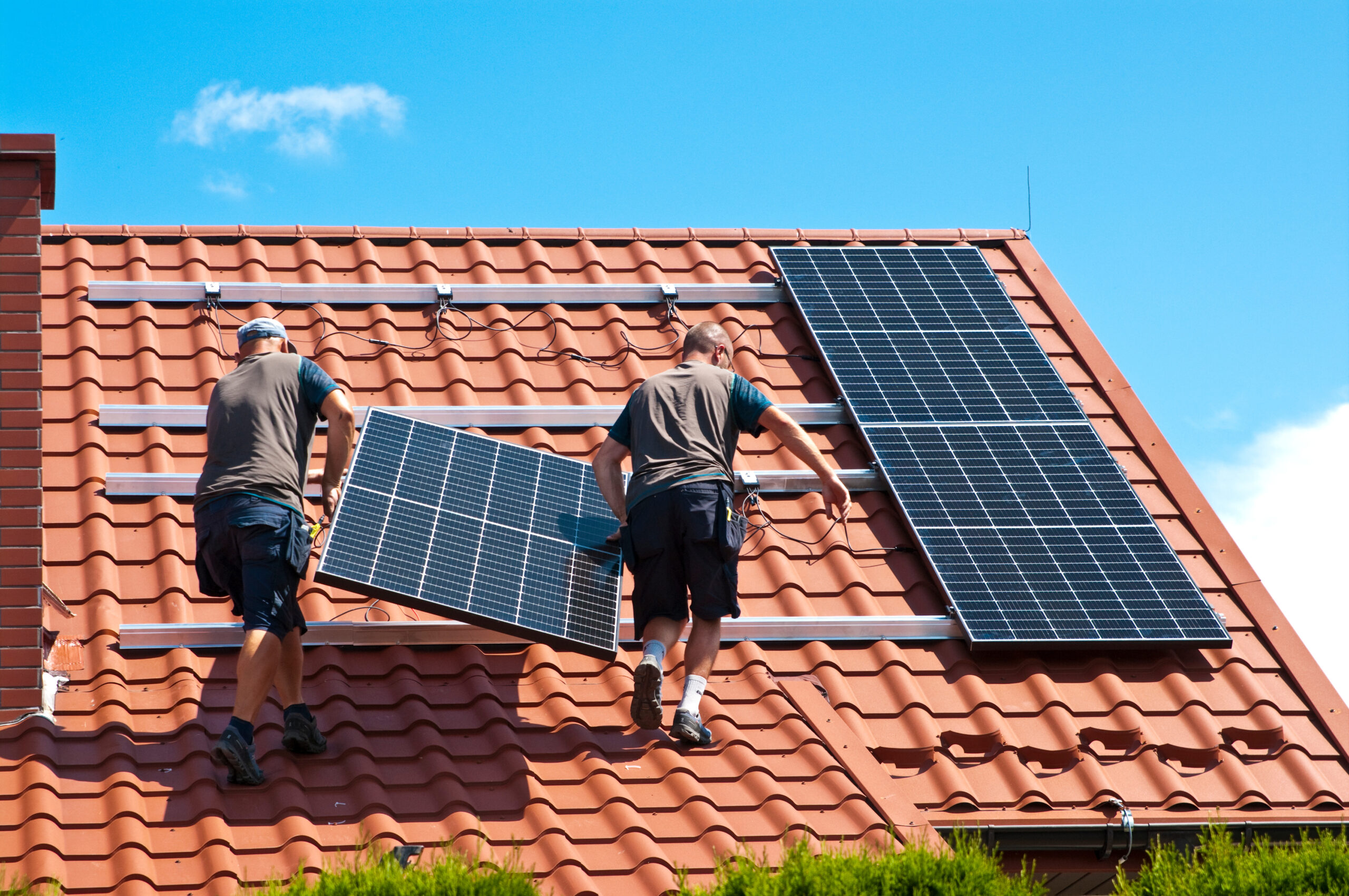
This is one reason simply measuring the width and height of your roof and dividing it by the dimensions of a solar panel can give a misleading answer.
Energy Saving Trust estimates that a typical 4.5kWp system using around 12 panels occupies roughly 20 to 30m² of roof surface.
Which Direction Your Roof Faces
Roof orientation affects how much energy the same number of panels can generate.
An unshaded south-facing roof is generally ideal for maximising generation in the UK. However, that does not mean you need a perfectly south-facing roof for solar to make sense.
East-facing and west-facing roofs can also work effectively. Energy Saving Trust estimates that systems facing east or west tend to generate around 15 to 20% less energy than equivalent systems facing directly south.
There can also be practical advantages to different orientations.
East-facing panels generate more strongly during the morning, while west-facing panels produce more in the afternoon and early evening. If those periods match when your household typically consumes electricity, the generation profile may suit your lifestyle particularly well.
How Much Shade Reaches The Roof
A large roof is not necessarily a good solar roof.
Trees, chimneys, neighbouring properties and other structures can cast shadows across panels and reduce their output.
Shading can sometimes matter more than roof direction. Energy Saving Trust notes that a shaded south-facing roof can potentially produce less than an unshaded east or west-facing roof.
A proper solar assessment should therefore consider how shade moves across the roof during different periods rather than simply identifying which direction the property faces.
Where unavoidable shading exists, the system design may incorporate technologies such as power optimisers or microinverters so one shaded panel has less impact on the rest of the array.
The Output Of Each Solar Panel
The number of panels is only half of the story.
Solar systems are normally described by their kilowatt-peak (kWp) rating. This is the maximum output of the complete array under standard test conditions.
For example, two homes might both have 10 solar panels but have different total system capacities because the panels themselves have different rated outputs.
That means comparing quotes based only on “number of panels” can be misleading.
Look at:
- Number of panels
- Wattage of each panel
- Total system size in kWp
- Estimated annual generation
- Roof layout and orientation
- Expected shading losses
Together, these provide a much more useful picture of the proposed system.
Can I Calculate How Many Solar Panels I Need Myself?
You can make a useful preliminary estimate, but an online calculation cannot fully replace a property-specific assessment.
One particularly useful starting point is the Energy Saving Trust solar panel calculator.
The calculator uses information about your property, location and energy use to estimate:
- How many solar panels may suit your roof
- Recommended system size
- Potential electricity generation
- Possible bill savings
- Indicative installation costs
Energy Saving Trust recommends using these results to prepare for a conversation with a solar installer, who can then provide advice based on your actual property.
That distinction is important. A calculator can give you a sensible starting figure. An installer can assess whether that figure makes sense once roof layout, shading, electrical requirements and the proposed equipment are taken into account.
A Simple Way To Think About Solar Panel Sizing
Rather than trying to calculate an exact panel number from electricity consumption alone, work through four questions.
1. How Much Electricity Do You Use Each Year?
Find your annual electricity consumption in kWh.
If possible, also look at when that electricity is being used. A smart meter or energy monitoring app can make this easier.
2. How Much Suitable Roof Space Do You Have?
Think in terms of usable, relatively unshaded roof area rather than the property’s total roof size.
An installer can then determine the practical panel layout.
3. What Size Solar Array Can The Roof Support?
Once a proposed panel model and layout are known, the installer can calculate the total kWp capacity.
For example, the number of panels alone tells you relatively little unless you also know their individual output.
4. How Much Electricity Is That System Expected To Generate?
This is where system design becomes more important than a simple panel count.
Expected annual generation depends on factors including:
- Geographic location
- Roof orientation
- Roof angle
- Shading
- Panel performance
- System losses
A good proposal should therefore give you an estimated annual generation figure rather than simply saying, “You need X panels.”
Should I Install Enough Panels To Cover All My Electricity Use?
Not necessarily.
It can be tempting to compare your annual electricity consumption with expected annual solar generation and aim for the two figures to match exactly.
The problem is that generation and consumption occur at different times.
Solar output is much higher during daylight hours and generally stronger in summer. Your household may consume substantial electricity during evenings and winter, when solar production is lower.
So even if your panels generate as many kilowatt-hours over a year as your home consumes, that does not mean you will become independent from the grid.
You may export surplus electricity at some times and import electricity at others.
This is why self-consumption, the amount of your solar electricity that you can actually use yourself, is an important part of system design.
Would A Solar Battery Change How Many Panels I Need?
It can influence the decision.
A solar battery storage system allows electricity generated by your panels to be stored for later rather than requiring you to use all of it at the moment it is produced.
For example, panels might generate surplus electricity around midday while nobody is home. A battery could retain some of that electricity for use during the evening.
Battery storage can therefore affect how you think about:
- The size of the solar array
- Daytime versus evening consumption
- How much generated electricity you use yourself
- Exporting electricity to the grid
- Smart electricity tariffs
Energy Saving Trust notes that batteries can store surplus solar electricity for later use and can also, depending on the setup, be charged when grid electricity is cheaper.
However, simply having a bigger battery does not automatically mean you should install more solar panels. Both should be sized around your household’s circumstances.
Think About The Electricity You May Use In Future
A common sizing mistake is designing a solar system entirely around today’s electricity bill.
Ask yourself whether your household could change substantially over the coming years.
You might be considering:
- Buying an electric vehicle
- Installing an EV charger
- Switching to a heat pump
- Working from home more often
- Adding an extension
- Installing air conditioning
- Adding electrically heated outbuildings
- Increasing the number of people living at the property
An electric vehicle in particular can materially change household electricity demand.
If you are likely to make one of these changes, tell your installer before the solar system is designed. It may be more practical to account for realistic future demand at the beginning than discover later that your original design no longer suits how you use your home.
Is It Better To Fit As Many Solar Panels As Possible?
Not automatically.
Filling every available part of a roof may increase total generation, but the largest possible installation is not necessarily the most appropriate one.
For example, additional panels could be positioned on a significantly shaded section of roof and contribute relatively little generation. In other cases, extra capacity may make perfect sense because the household has high electricity consumption, plans to charge an EV or can make useful use of surplus generation.
A better objective is:
Fit the amount of well-positioned solar capacity that makes sense for the property’s roof, electricity demand and future plans.
That is more useful than aiming for the maximum possible panel count simply because space is available.
Common Solar Panel Sizing Mistakes
Choosing A System Based Only On The Number Of Bedrooms
Property size can provide a rough indication of electricity demand, but it cannot tell you exactly how a household uses energy.
Two four-bedroom homes can have dramatically different consumption.
Use your actual electricity data wherever possible.
Looking Only At Annual Electricity Consumption
Annual consumption is useful, but your daily pattern matters too.
Think about when you use power and how much solar electricity could realistically be consumed while it is being generated.
Ignoring Shading
More panels do not necessarily produce more useful electricity if several are poorly positioned.
A careful layout can be more valuable than simply maximising panel numbers.
Forgetting About An EV Or Heat Pump
A system designed around today’s electricity use may no longer be ideal if your household becomes more electrified.
Discuss foreseeable changes before finalising the design.
Comparing Solar Quotes By Panel Count Alone
Ten panels from one proposal are not necessarily equivalent to 10 panels in another.
Compare total system capacity, equipment specifications, estimated annual generation and proposed layout as well.
How Many Solar Panels Will Actually Fit On My Roof?
Energy Saving Trust provides a useful broad indication based on typical UK house types: around four panels for a mid-terrace, eight for an end-terrace or semi-detached property, 12 for a small detached house and 16 for a large detached house.
But real homes rarely fit perfectly into a table.
A semi-detached property with a simple, uninterrupted roof could potentially have more usable space than a larger detached property with dormers, valleys, chimneys and substantial shading.
That is why roof suitability should be assessed individually.
Does Living In Norwich Affect How Many Solar Panels I Need?
Location forms part of the calculation because the amount of solar energy available varies around the UK.
However, postcode alone does not determine how many solar panels a Norwich home needs. Roof orientation, shading, usable space and household electricity use remain fundamental factors.
For homeowners in Norwich and the surrounding area, ACS Solar can assess these factors together and recommend a system based on the individual property rather than relying on a generic panel number.
You can read more about solar panel installation and what is involved before deciding whether to request an assessment.
Frequently Asked Questions
How Many Solar Panels Does The Average UK Home Need?
There is no universal requirement, but Energy Saving Trust says an average 4.5kWp solar system typically uses around 12 panels and occupies approximately 20 to 30m² of roof area. Your appropriate system could be smaller or larger depending on your roof and electricity consumption.
Is 10 Solar Panels Enough To Power A House?
It depends on the output of the panels, how much electricity the household consumes, where and how the panels are positioned, and what you mean by “power a house”.
Ten panels may generate a substantial amount of a household’s annual electricity, but solar generation does not happen evenly throughout the day or year. Most grid-connected homes will still import electricity at certain times.
How Do I Know What Size Solar System I Need?
Start with your annual electricity consumption, usable roof space, roof orientation and shading. Then consider future requirements such as an EV or heat pump.
An online solar calculator can provide a preliminary estimate, but a tailored system design should consider the individual property.
Can I Use A Solar Panel Calculator?
Yes. The Energy Saving Trust solar panel calculator is a useful independent starting point. It estimates potential panel numbers, system size, costs and savings using information about your home and energy use.
Treat calculator results as estimates rather than a final system design.
Can I Add More Solar Panels Later?
It may be possible, but expanding an existing system can involve considerations around available roof space, inverter capacity, electrical configuration and other equipment.
If you think your electricity consumption is likely to increase, mention this when the original system is being designed.
Do I Need Battery Storage With My Solar Panels?
No. Solar panels can operate without a battery.
A battery can, however, store surplus electricity for use later, which may be useful if your household generates electricity during the day but consumes more power in the evening. Whether it makes sense depends on your consumption pattern, solar system and goals.
Start With An Estimate, Then Size The System Around Your Home
So, how many solar panels do you need? For many UK homes, the answer may fall somewhere within the broad range of four to 16 panels, with Energy Saving Trust citing around 12 panels for a typical 4.5kWp system. But a generic number should never be the final answer.
Your electricity usage, roof layout, orientation, shading, panel specification, battery plans and future energy requirements all matter.
Using an independent calculator is a useful first step. Once you have an idea of what could suit your property, a proper assessment can turn that estimate into a practical system design.
If you are considering solar for your home, explore ACS Solar’s solar panel installation services or contact our team to discuss your property and electricity requirements.